Is FaxZero Safe? The Real Security Risks You Need to Know
So, is FaxZero actually safe to use? The short answer is, it really depends on what you’re sending.
For something casual, like a restaurant menu or a quick note to a friend, FaxZero is perfectly fine. It's a handy, free tool for simple tasks. But for anything that contains sensitive information—think medical records, legal documents, or financial statements—its security just doesn't cut it.
Understanding FaxZero's Safety Profile
Think of it like this: using FaxZero is a bit like sending a postcard. A postcard is great for a quick "hello," but you'd never dream of writing your bank account details on the back for everyone to see. For that, you'd use a sealed, certified letter.
FaxZero is the postcard of the online faxing world. It's built for convenience, not for ironclad security. This guide will walk you through exactly what FaxZero does to protect your faxes, where the real risks are, and how you can figure out if it's the right choice for your specific document.
Where FaxZero Shines and Where It Falls Short
Let's give credit where it's due. FaxZero has sent over 27 million faxes since it started back in 2006, which shows a lot of people trust it for everyday faxing. The service uses basic web security like HTTPS when you upload your file and SSL/TLS to send the fax. These are standard, necessary protections.
However, "standard" isn't the same as "secure." The encryption isn't what you'd find in an enterprise-level service, and their policy of keeping your data indefinitely creates a major long-term privacy headache. You can get a deeper look into FaxZero's user stats and security features to see the full picture.
Ultimately, whether FaxZero is "safe" really comes down to what you're trying to protect.
To help you decide, let's break it down by a few common scenarios in this quick summary table.
FaxZero Safety Profile at a Glance
| Use Case Scenario | Is FaxZero Safe? | Primary Concern |
|---|---|---|
| Casual, non-sensitive documents (e.g., flyers, simple forms) | Yes, generally. | Minimal risk for non-confidential information. |
| Standard business documents (e.g., invoices, internal memos) | Use with caution. | Data retention policies and lack of advanced security. |
| Regulated or highly sensitive data (e.g., medical, legal, financial) | No, not recommended. | No HIPAA compliance; significant privacy and security risks. |
As you can see, the risk level changes dramatically based on the contents of your fax.
Here’s a simple way to think about it:
- Casual Use: Sending a flyer, a simple confirmation page, or a non-confidential form? For these kinds of tasks, the convenience of FaxZero is probably worth the tiny risk.
- Business Use: Transmitting invoices, routine client communications, or internal memos? This is where things get murky. Even seemingly harmless business data can be sensitive if it falls into the wrong hands.
- Regulated Data: Sending documents with Protected Health Information (PHI), financial records, or signed legal contracts? Using FaxZero for these is a huge gamble and could even put you in violation of compliance rules like HIPAA.
When you're looking at free online tools, you always have to be aware of the trade-offs. While you might be tempted to just send a fax online for free, always let the sensitivity of your document guide your choice, not the price tag.
What Real Security Means for Online Faxing
Before we can really size up a service like FaxZero, we have to get on the same page about what "safe" actually means in the world of online faxing. It’s about way more than just seeing that little padlock icon in your browser. Real security is a whole system of defenses, designed to protect your information at every step of its journey.
Think of it like sending a sensitive package. You wouldn't just toss it in a public mailbox and hope for the best, right? You’d want to know it's guarded from the moment it leaves your hands until the second your recipient signs for it.
That journey has a few critical checkpoints we need to look at.
Encryption In Transit vs. Encryption At Rest
The first thing to wrap your head around is the difference between data "in transit" and data "at rest." It’s a simple concept, but it’s the foundation of all data security.
-
Encryption in Transit: This is all about protecting your document while it’s actively moving across the internet—from your computer to the fax service's servers. It’s like putting your package inside an armored truck for the trip. Most services, FaxZero included, use standard SSL/TLS for this, which is a good, necessary first step.
-
Encryption at Rest: This is about what happens to your document after it arrives at the service's servers. Is it just sitting in an unlocked warehouse, or is it locked away in a secure vault? Encrypting data at rest means your files are scrambled and unreadable, even if a hacker managed to break into the server itself.
This infographic breaks down the two very different paths your documents can take.
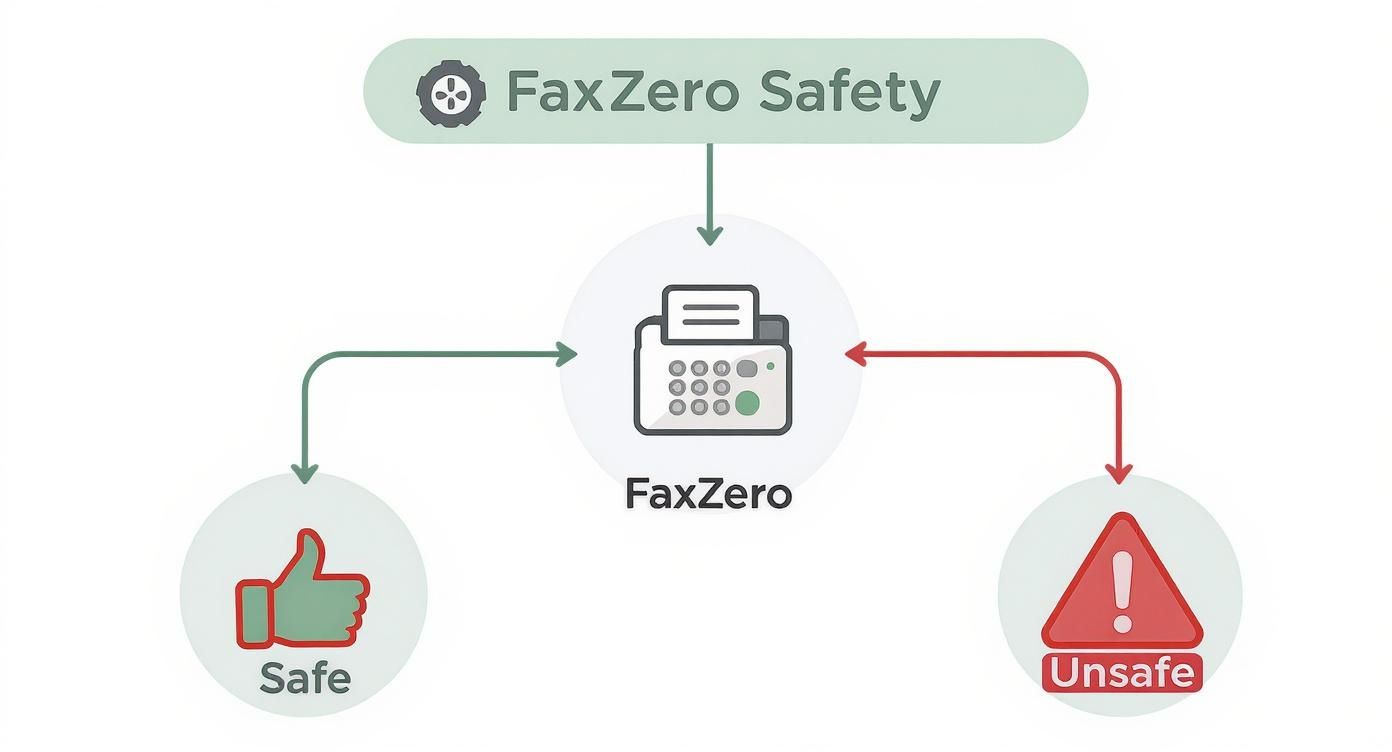
As you can see, there's a huge difference between the basic protection you might get for a non-sensitive fax and the gaping holes left when sending something confidential. A service that only protects data while it's in transit is leaving your information dangerously exposed.
The Bigger Security Picture
Beyond just encryption, a truly secure service is built on a whole framework of protections. It’s like vetting a security company—you’d look at more than just the locks on their doors.
A secure fax service acts as a digital custodian for your information. Its responsibility isn't just to transmit the data but to protect its integrity, confidentiality, and availability from start to finish. Without this complete chain of custody, "security" is just a marketing term.
This means we need to look at a service with a broader checklist in mind:
- Access Controls: Who can actually get to your data? Features like two-factor authentication (2FA) are critical for stopping someone from getting in with just a stolen password.
- Data Retention Policies: How long does the service hang onto your faxes and personal information? A service that promptly deletes your data after sending it is actively minimizing your long-term risk.
- Regulatory Compliance: Does the service meet legal standards like HIPAA for medical records or GLBA for financial data? For any professional use, this is a dealbreaker.
- Audit Trails: Can you get a detailed log of every single thing that happened to your fax? This is crucial for accountability and figuring out what went wrong if there's a problem.
Getting a handle on these concepts is key, especially when you think about modern workflows like converting a fax to email, where your data touches multiple systems. With this security checklist in hand, you’re ready to properly evaluate any online fax service—including FaxZero—and decide if it’s truly safe enough for what you need to send.
Analyzing FaxZero's Security Strengths and Weaknesses
When you use any online service to send a document, you're essentially handing over your information and trusting them to keep it safe. So, to figure out if FaxZero is truly a safe bet, we need to look at both what it does right and, more importantly, where it drops the ball. On the surface, FaxZero has some basic protections in place, but digging just a little deeper reveals some serious gaps for anything even remotely sensitive.
FaxZero's main strength lies in how it protects your data in transit. As you upload a file, the service uses HTTPS to create a secure, encrypted tunnel between your computer and its servers. It also uses SSL/TLS to protect the fax while it's traveling from their system to the recipient's fax machine. These are the modern standards, and they work well for shielding data on the move.
You can think of this like an armored truck. While your document is on the road, it’s pretty well-protected from anyone trying to peek at it mid-journey. For something non-sensitive, like a lunch menu or a flyer, this is probably good enough.
The Problem with Data at Rest
The real trouble begins once that armored truck reaches its destination: FaxZero's servers. After your document arrives, the protection basically stops. Your files are stored unencrypted on their servers, a state we call "data at rest."
This is like the armored truck driver taking your sensitive package and just leaving it on an open warehouse floor instead of putting it in a secure vault. Anyone with access to that warehouse—a disgruntled employee, a hacker who gets past the main gate—can just walk right up and read whatever is inside.
Storing user data without encryption at rest is a critical security failure. It turns a service's servers into a high-value target for data breaches, as a single successful attack could expose every document stored there in a readable format.
Honestly, this single weakness is a deal-breaker for sending anything you consider private. Without encryption for stored files, there's just no guarantee of your data's long-term safety.
Missing Modern Security Standards
Beyond the glaring data storage issue, FaxZero's security setup feels a bit stuck in the past. It’s missing key features that have become standard for any service that handles personal information. These missing layers of defense make you question if FaxZero is safe for anything beyond the most casual, unimportant faxes.
A few crucial security features are noticeably absent:
- No Two-Factor Authentication (2FA): Since you don't create a permanent account, there's no way to add that extra security step, like a code sent to your phone. This is a fundamental security feature today, and it’s just not there.
- No Audit Trails: The service doesn't give you a detailed log of when your fax was sent, viewed, or handled. For business or legal documents, this lack of a verifiable paper trail is a major red flag.
- Basic Encryption Only: While SSL/TLS is fine for transit, it's not the robust, end-to-end encryption needed for regulated industries. For example, it doesn't meet the AES-256 encryption standard that's often a baseline requirement for protecting healthcare and financial data.
At the end of the day, FaxZero is built for convenience, not for serious protection. It gives you the bare minimum to get a document from point A to point B but completely fumbles the job of securing it for its entire lifecycle. This lopsided approach makes it a risky choice for anything you wouldn't feel comfortable sending on the back of a postcard.
Your Privacy and FaxZero's Data Retention Policy
Getting your fax from point A to point B securely is just the first hurdle. What happens to your information after it’s delivered is the second, and frankly, often overlooked part of the privacy puzzle. When you start digging into FaxZero’s privacy policy, one detail immediately jumps out: its approach to data retention.
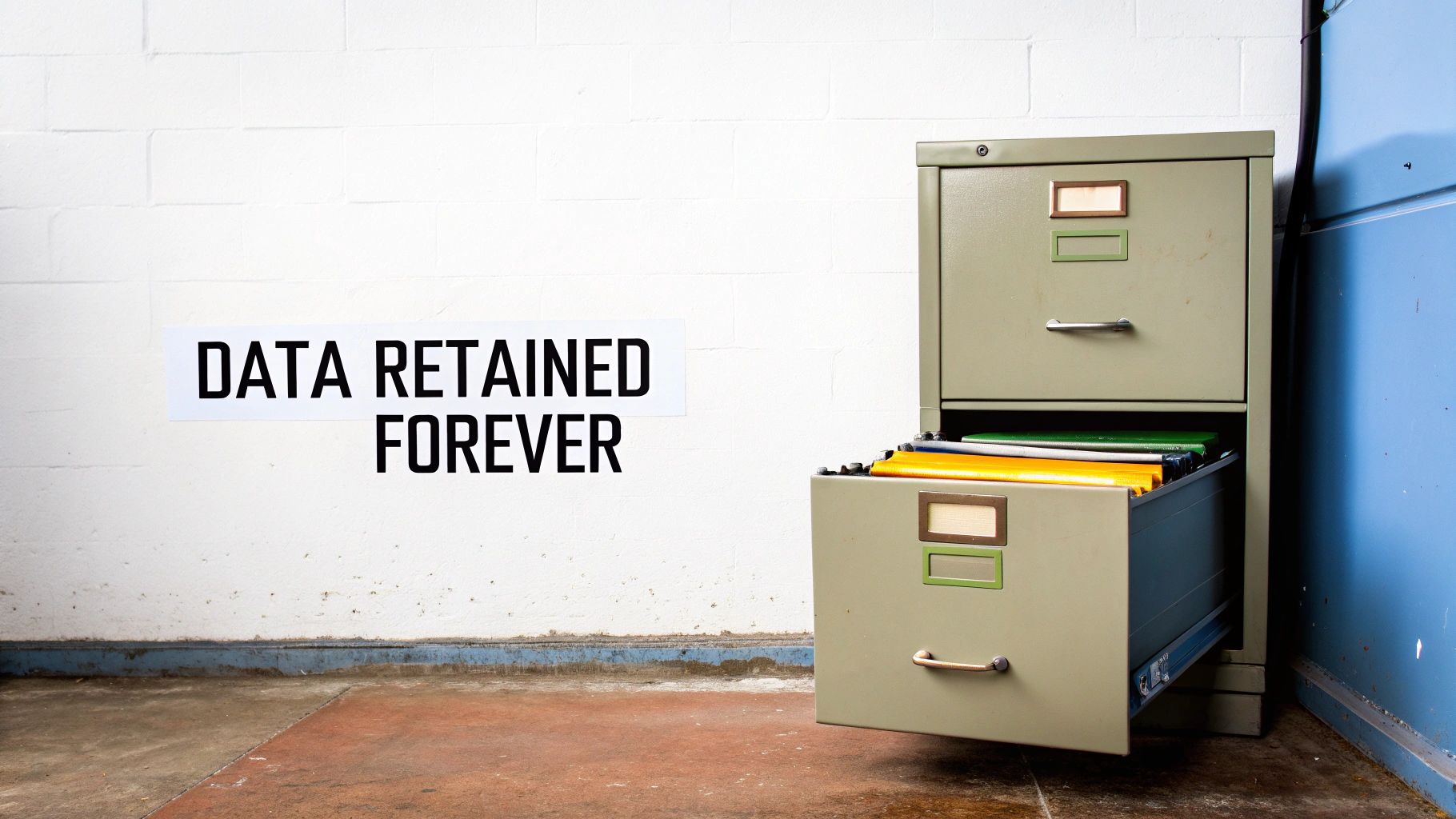
While FaxZero may delete the actual content of your fax after some time, their policy explicitly states they can hang onto your metadata forever. This isn’t junk data; it’s a digital trail that includes your name, email address, your phone number, and the recipient’s details.
Here’s a simple way to think about it: the service eventually shreds the letter you sent, but it keeps the envelope—with all the sender and recipient info—in a filing cabinet, indefinitely. This creates a permanent, undeniable record linking you to a specific fax, which opens up its own can of worms.
The Long-Term Risks of Indefinite Retention
So, why is keeping this metadata such a big deal? The longer a company stores your personal information, the more opportunities there are for it to be exposed or misused. Even with the best intentions, that permanent digital footprint creates vulnerabilities.
Think about these real-world scenarios:
- Data Breaches: If FaxZero ever got hacked, all that stored metadata becomes a goldmine for cybercriminals. A neat list connecting senders to recipients could expose sensitive business relationships, confidential legal matters, or private personal connections.
- Company Acquisition: Should FaxZero ever be sold, its user database is a valuable asset. The new owners could potentially use all that historical data in ways you never consented to when you signed up.
- Unintended Use: Company policies can and do change. Data that’s kept on file forever could be repurposed for marketing or analytics down the road, even if that wasn’t the original plan.
This "keep it forever" policy is a world away from how truly security-focused services operate. Many top-tier platforms prioritize minimizing your digital footprint by offering automatic and complete data deletion. Once your fax is delivered, all records—the content and the metadata—are permanently wiped from their servers.
"A service's data retention policy is a direct reflection of its commitment to user privacy. Indefinite retention creates a permanent liability for the user, turning a one-time transaction into a long-term risk."
Ultimately, when you ask, is FaxZero safe, you have to look beyond the moment you click "send." The digital trail you leave behind can be just as risky as the transmission itself. A service that holds onto your personal details forever is asking for a huge amount of trust in its future security practices—a risk that might not be worth taking, especially when sending anything sensitive.
Why FaxZero Fails Critical Compliance Tests
When you step out of the world of casual faxing and into a professional setting, the rules change dramatically. Suddenly, you're dealing with industries like healthcare, finance, and law, all of which operate under a microscope of strict data protection laws. Get it wrong, and you're not just looking at a slap on the wrist—you're facing serious penalties.
This is exactly where FaxZero’s free model hits a brick wall. It's simply not built for professional use, making it an unsuitable and, in many cases, an illegal choice.
The biggest red flag is its relationship with the Health Insurance Portability and Accountability Act, better known as HIPAA. This is the federal law that dictates how sensitive patient health information (PHI) must be protected. Any business or tool that touches PHI has to play by HIPAA's very strict security and privacy rules.
Let's be perfectly clear: FaxZero is not HIPAA compliant. Using it to send any document with patient information on it is a direct violation of federal law.
The HIPAA Compliance Dealbreakers
FaxZero's failure to meet HIPAA standards isn't a small oversight; it's baked into its very design. A few core issues make it a complete non-starter for anything related to healthcare.
First, the encryption just isn't there. HIPAA demands strong security measures to shield data while it's traveling (in transit) and while it's sitting on a server (at rest). FaxZero doesn't provide the level of encryption required and fails to secure the data once it lands on their systems.
Second, and this is the big one, FaxZero will not sign a Business Associate Agreement (BAA). A BAA is a legal contract required by HIPAA that gets signed between a healthcare provider and any third-party service that handles its patient data. This contract makes the service provider legally responsible for protecting that information, too.
Without a signed BAA, sending patient information through a third-party service is an automatic HIPAA violation. Full stop. Since FaxZero won't provide one, it's instantly disqualified for any and all healthcare use.
Beyond Healthcare: Other Regulated Industries
The compliance problems don't end with medicine. Plenty of other industries have their own data security standards that FaxZero just can't meet.
- Financial Services (GLBA): The Gramm-Leach-Bliley Act mandates that financial institutions protect their customers' private financial information. FaxZero’s weak security and lack of audit trails make it a poor choice for sending loan applications, bank statements, or any other sensitive financial documents.
- Legal Professionals (Attorney-Client Privilege): Lawyers have a legal and ethical duty to maintain absolute client confidentiality. Sending privileged documents over an insecure service like FaxZero opens the door to interception and exposure, which could blow up a case.
FaxZero’s entire system just wasn't designed for these high-stakes scenarios. Industry analysis confirms that the service doesn't have the necessary infrastructure, like 256-bit encryption, putting it miles behind competitors built for business. It wasn't made for regulated data, and its limitations even affect document quality, often mangling faxes with a lot of graphics. If you want to dig deeper into its overall service limits, you can explore detailed comparisons of online fax providers.
At the end of the day, if your work involves any kind of confidential client, patient, or customer data, the answer to "is FaxZero safe?" is a hard no. The risk of a data breach, legal fines, and damage to your professional reputation is just too high to justify using a free service.
Secure Alternatives to FaxZero
After taking a hard look at FaxZero's security gaps, it becomes obvious that its free service just isn't built for sending sensitive information. If you work in healthcare, finance, or law—or really, if you handle any kind of confidential data—finding a secure alternative isn't optional. It's essential.
Thankfully, there are plenty of online fax services designed from the ground up with serious security and compliance in mind. These paid services offer a completely different world of protection. We’re moving beyond basic transmission security to a full suite of features that guard your documents from start to finish. This flips the script from a risky "send and hope" approach to a secure, trackable, and verifiable way of communicating.
What to Look For in a Secure Fax Service
When you start comparing professional online fax services, you'll immediately see features that FaxZero simply doesn't offer. These are the non-negotiables for keeping your faxes private and in line with industry rules.
-
End-to-End Encryption: This is the gold standard. Look for services that use powerful encryption like AES-256 to protect your data both while it’s traveling (in transit) and while it's stored on their servers (at rest). This means your files are unreadable even if someone managed to access the server.
-
HIPAA Compliance: If you’re faxing anything related to healthcare, the service must be HIPAA compliant. A huge part of this is their willingness to sign a Business Associate Agreement (BAA)—a legal contract that holds them accountable for protecting patient information.
-
Detailed Audit Trails: Unlike the black box of a free service, secure providers give you a complete history for every fax. You can see exactly when a document was sent, when it was delivered, and even when it was viewed. This creates a rock-solid record for legal or compliance needs.
The real difference between a free service and a secure one comes down to accountability. A genuinely safe alternative gives you verifiable proof of its security measures—from encryption standards to legally binding compliance agreements. Your data is protected by more than just a promise.
Finding the Right Fit for Your Needs
The best service for you will depend on your specific situation, like how many faxes you send and what industry you're in. Platforms like SRFax and Documo are tailored for healthcare and legal professionals, with HIPAA compliance ready to go. Others, such as MyFax or eFax, are geared toward small businesses with features designed for everyday office use.
If you’re looking for a simple, secure option that directly solves the problems we found with FaxZero, SendItFax is a clear step up. It operates on a pay-per-fax model, so you don't need a monthly subscription, but you still get the peace of mind that comes with secure transmissions.
To help you sort through all the options, our online fax services comparison gives a detailed breakdown of features, pricing, and compliance standards for the top providers. Taking a few minutes to make an informed choice is the best way to ensure your confidential documents get the protection they demand.
Got Questions About FaxZero? Let's Clear Things Up.
Even after digging into the details, you might still be wondering about a few specific scenarios. Let's tackle some of the most common questions head-on so you can decide if FaxZero is truly the right tool for the job.
Can I Safely Use FaxZero for Legal Documents?
I would strongly advise against it. Legal documents are in a class of their own—they’re often protected by attorney-client privilege and are packed with sensitive client information.
FaxZero simply doesn't have the necessary safeguards. The files aren't encrypted while sitting on their servers, and their policy of holding onto your metadata forever just creates too much risk. When it comes to legal paperwork, you need a service that’s built for compliance and gives you a clear audit trail.
Does FaxZero Sell My Personal Data?
Their privacy policy doesn't come right out and say they sell your data, but the real issue is how long they keep it. FaxZero hangs onto your name, email, and phone number indefinitely.
Think of it as a permanent digital footprint you can't erase. If FaxZero ever had a data breach or was sold to another company, that information could easily be exposed or used in ways you never intended.
If you care about your privacy, that policy alone should be a major red flag.
Is the Paid FaxZero Plan More Secure?
Unfortunately, no. Paying for their "almost free fax" service does not get you any extra security. All it does is remove the FaxZero logo from the cover page and let you send more pages at once.
The underlying security setup is identical for both free and paid users. You're still dealing with the same fundamental weaknesses:
- Your faxes are stored without encryption on their servers.
- Your personal details are kept forever.
- There are no modern security features like two-factor authentication.
Upgrading buys you a bit of convenience, but it does nothing to address the core security and privacy problems. If you're sending anything sensitive, you really need to look for a more secure alternative.
If you're looking for a simple, secure way to send faxes without worrying about your data sticking around forever, SendItFax was built to be a clear alternative. Send your fax with confidence and move on with your day. Learn more and send your first fax securely at SendItFax.
Related Posts
Faxes or Faxs: The Correct Plural Spelling
How to Fax from Computer Mac: Free Online Method