Fax Number in US: Format, Dialing and Cloud Routing
You've been asked to send a signed contract, referral, or medical record to a US fax number before a deadline. The recipient gives you a ten-digit number, but you still need to know whether it's current, how to dial it, and whether the fax ends at a physical machine or a cloud inbox. A correctly formatted number is only the starting point. Active routing and recipient verification determine whether the document reaches the right person.
Why US Fax Numbers Still Matter Today
A healthcare office may need to send a referral before a patient's appointment. A lawyer may need to transmit a signed filing or a confidential contract. In both cases, email might be available, but the receiving organization may still require fax because its workflow, audit process, or department intake system is built around fax delivery.
Fax remains particularly persistent in US healthcare. Recent federal and industry reporting says roughly 70% of healthcare providers still exchange medical information by fax, while about 89% of healthcare organizations reported using fax machines in an MGMA poll of nearly 1,600 leaders, as summarized by healthcare fax statistics and automation reporting. The same source reports that US healthcare exchanges more than 9 billion fax pages annually, which shows why a fax number remains an active business endpoint rather than a historical curiosity.
The reason isn't that professionals prefer old technology. Fax provides a defined destination, a transmission record, and a familiar process for regulated document exchange. Email can be encrypted, but ordinary email by itself doesn't guarantee that the recipient's mailbox, department, or document-handling process meets your requirements.
Practical rule: Treat a fax number like a delivery address, not like a piece of contact information you can copy without checking.
Fax also remains part of broader health-information exchange patterns. A summary of a federal report states that in 2019 nearly 8 in 10 hospitals used mail or fax to send and receive health information, and that fax or mail remained the most common method for care-record summaries, according to Medscape's overview of fax use in oncology practices. That context matters for anyone looking for a fax number in the US. The number may connect to a hospital department, an insurer, a law office, a shared intake desk, or a digital service that still accepts fax as part of its workflow.
Anatomy of a US Fax Number Format
A US fax number follows the same basic numbering structure as other US telephone numbers. The number has 10 domestic digits, divided into a 3-digit area code and a 7-digit local number. When you dial from outside the United States, or when a service requires international formatting, you'll commonly add the country code +1.
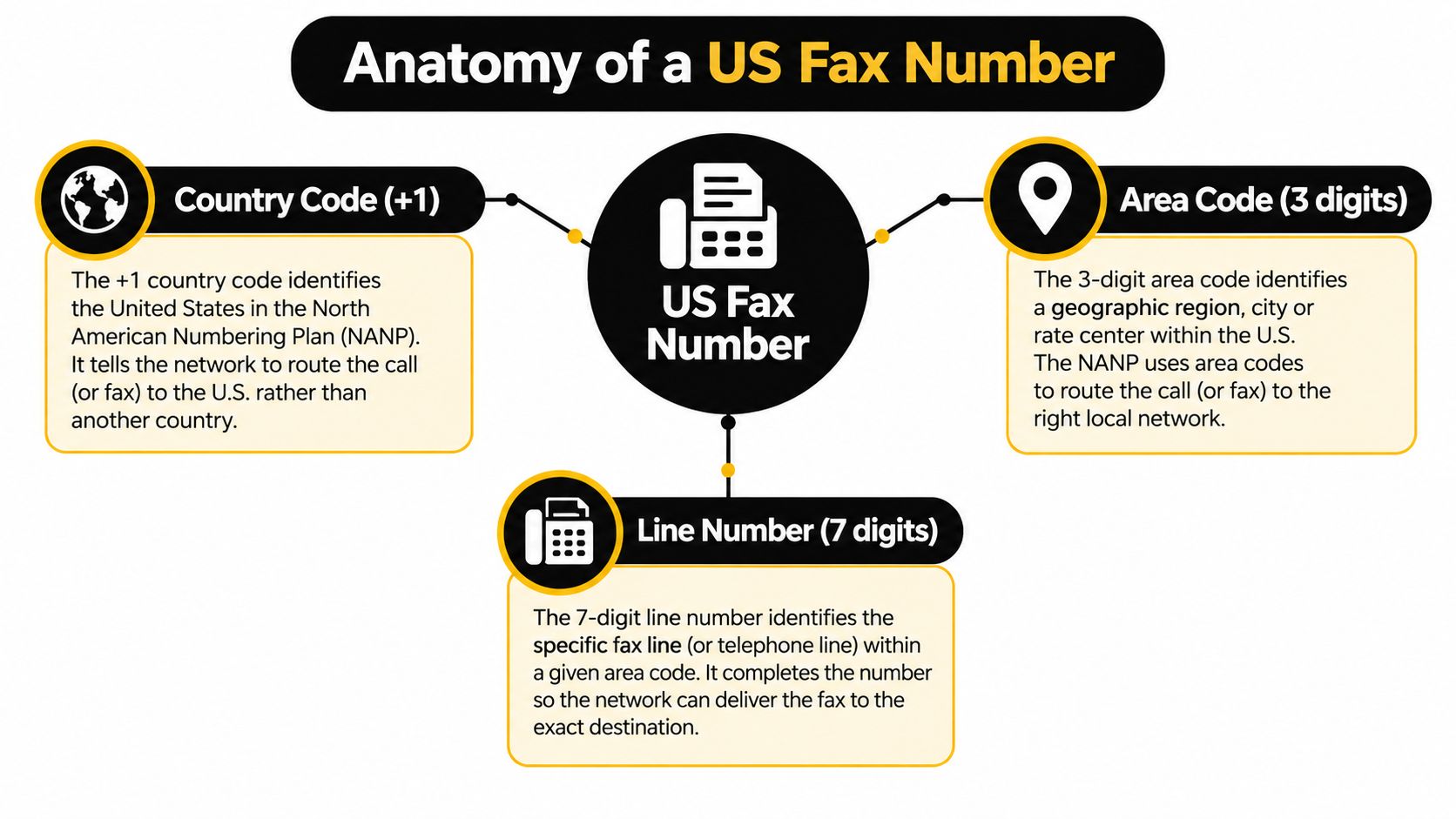
Think of the number as a postal address for telecom routing:
- Country code, +1. This identifies the North American Numbering Plan region when the sender is dialing internationally or entering a full international destination.
- Area code, three digits. This is the geographic or service routing key. A geographic area code points toward a numbering region, while a toll-free prefix identifies a non-geographic service.
- Local number, seven digits. This identifies the particular fax line or service endpoint within that numbering region.
For a domestic workflow, the full sequence may be written as 1 plus the area code and local number, or as the ten-digit number alone, depending on the telephone system or online fax form. A company PBX may also require an outside-line prefix before the number. That prefix belongs to the sender's phone system, not to the recipient's fax number, so don't add it when saving the destination in a shared directory.
You can find a useful visual explanation of this structure in how many numbers are in a fax number. The key distinction is between a geographic fax number and a toll-free fax destination. Reserved toll-free prefixes include 800, 888, 877, 866, 855, 844, and 833, and they replace a geographic area code rather than identifying a particular city or region, as explained in this guide to US fax number structure.
A local-looking number also doesn't prove that the recipient operates a physical office in that area. The area code describes the numbering assignment, while the actual service may route calls and fax transmissions to another location or to cloud software.
The Shift to Cloud Fax Endpoints
The most important change in US faxing concerns where the number terminates. Years ago, a fax number usually pointed to a machine in an office. Today, it may route into a secure online inbox, a shared departmental queue, a document-management platform, or an electronic health record workflow.

That shift changes how you should interpret a request for a “local” fax number. A number with a New York, Texas, or California area code may be assigned to a cloud fax account used by a remote team elsewhere. Conversely, an organization with a national toll-free number may use software routing to send documents to separate teams based on the destination number, cover-page details, or internal rules.
Cloud fax services can accept documents through a browser or application instead of requiring staff to stand beside a machine. They may support digital attachments, cover-page fields, delivery notifications, searchable records, and routing to an individual inbox. The exact features vary, so confirm what the recipient's service supports before assuming that every fax endpoint handles attachments or automated notifications in the same way.
A recent industry summary says 40% of US health system and hospital executives had adopted a cloud-based fax solution, indicating that fax is moving into software workflows rather than just disappearing, as described in coverage of the healthcare cloud fax transition. The practical implication is straightforward: the question isn't only “does this number belong to a fax machine?” It's “which system receives the transmission, and who monitors that system?”
For an overview of the technology, see cloud-based fax solutions. A remote worker may send to a US number from a browser, while the recipient sees the document in a digital queue. That can make delivery faster to manage, but it can also hide changes in ownership, department routing, or access permissions. A number can remain active while the intended team no longer checks it.
Verifying Active Routing Before Sending
A valid-looking number doesn't guarantee a successful or appropriate delivery. The line may be disconnected, shared by several departments, forwarded to a different service, or active but no longer monitored by the person named in your records.
That risk is serious for medical records, legal documents, financial forms, and any file containing personal information. Federal health-IT data reported through fax-use and interoperability analysis says 71% of US hospitals used mail or fax to send summary-of-care records and 68% used it to receive them in 2019. The same source says only 43% of hospitals were routinely interoperable across all four electronic-exchange domains in 2023, so fax continues to function as a fallback channel in many workflows.
Confirm the destination before transmission
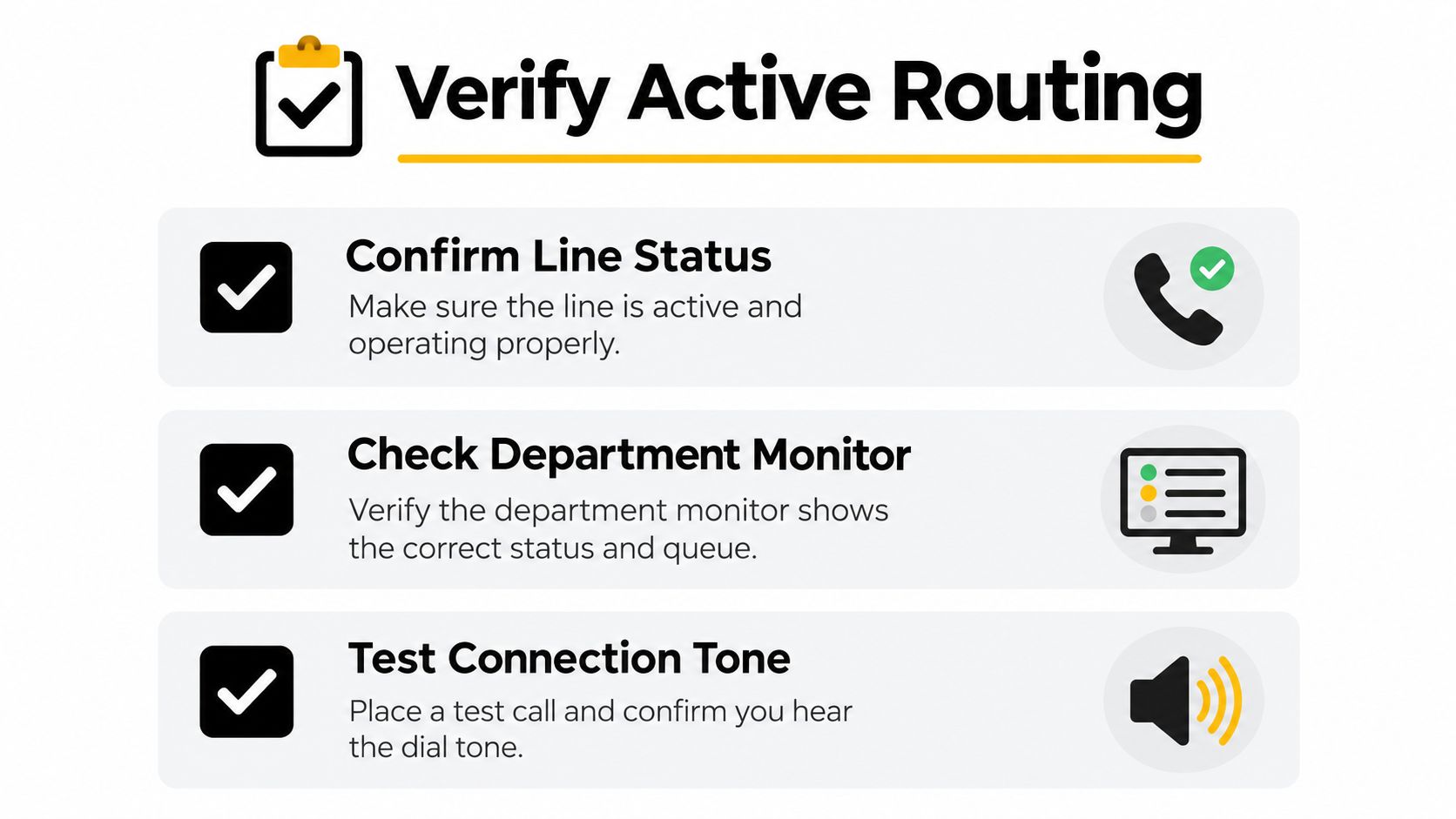
Use a short verification routine:
- Confirm line status: Call the organization using a trusted phone number from its official website or an existing business record. Ask whether the fax number is still active.
- Check department ownership: Confirm the exact department, recipient, and purpose of the line. “Medical records” and “referrals” may use separate endpoints.
- Test the connection: If the recipient agrees, send a non-sensitive test page or ask whether the line is currently receiving transmissions. Don't use confidential information for testing.
- Request delivery confirmation: Record the transmission result, time, recipient, and any confirmation number supplied by your fax service.
- Update your directory: Replace outdated entries immediately so the next employee doesn't reuse an unverified number.
A phone validation service can help clean and assess contact data before outreach, especially when a team maintains many business records. For example, a phone validation tool for real estate can support list checking, but validation isn't the same as confirming that a particular department actively monitors a fax endpoint.
The safest process combines technical validation with human confirmation. Fax number verification guidance can help structure that process, but the recipient organization remains responsible for confirming its current routing.
Dialing Rules and Browser-Based Delivery
Once the recipient confirms the endpoint, enter the number in the format required by your sending system. For a US destination, that normally means the 10-digit area code and local number. If the service accepts international formatting, use +1 followed by those 10 digits. Some systems accept a leading 1 instead.
Check your organization's PBX rules if you're dialing from a physical phone or office fax machine. Some systems require an outside-line access code, while others use a full ten-digit dialing pattern automatically. Never assume that a number copied from an email includes the correct exit code for your office telephone system.
Browser-based delivery removes much of that uncertainty. Instead of entering a number on a machine, you can generally:
- Open the online fax service.
- Enter the recipient's confirmed US fax number.
- Upload the document in a supported format.
- Add the recipient, sender, and department details.
- Include a cover page when it helps the recipient identify the document.
- Review the number and attachment before sending.
- Save the delivery result for your records.
A web service may also offer optional priority handling, digital cover-page messages, or a delivery status display. Those features don't replace recipient verification. They only make the transmission process easier to control after you've confirmed the destination.
Before clicking send: Compare the number on screen with the number confirmed by the recipient, then check the attachment and cover page for unintended information.
Fax over IP introduces another technical consideration. Many systems use T.38 as the fax relay mode because it preserves real-time modem signaling across packet networks. Guidance from a T.38 fax vendor recommends setting the default fax mode to T.38 auto, reflecting the fact that fax transmission over VoIP needs handling designed for packet loss, jitter, and voice-network behavior rather than ordinary audio alone, as described in this T.38 fax and VoIP guidance.
If a transmission fails, don't repeatedly resend sensitive material without checking the cause. Confirm the number, ask whether the line is available, review the service's error message, and determine whether the recipient uses a machine, a hosted endpoint, or another managed workflow.
Best Practices for Secure US Faxing
Reliable faxing depends on a small set of repeatable habits. The number format gets the document to the right network destination, but operational controls help get it to the right human or department.
Use a verification-first workflow
Keep a shared directory with the fax number, organization, department, verification date, and the person who confirmed it. When a recipient changes offices or departments, update the entry rather than adding a second unverified number.
Use a cover page when it supports safe handling. Include the intended recipient, department, sender contact details, document description, and a confidentiality notice appropriate to your organization. Keep sensitive information out of the cover page itself because the cover can be viewed before the rest of the document.
Match the method to the document
For an occasional transmission, a browser-based service can avoid maintaining a physical fax machine. SendItFax accepts DOC, DOCX, and PDF uploads for US and Canadian destinations, including toll-free fax numbers, and lets users add an optional cover-page message. Its free option supports up to three pages plus a cover, with a daily limit of five free faxes and branding on the cover page, while the Almost Free option costs $1.99 per fax, supports up to 25 pages, offers priority delivery, and removes that branding, according to the publisher's product information.
For recurring regulated workflows, evaluate retention, access controls, audit records, recipient notifications, and integration with the systems your staff already use. A cheap transmission method may not satisfy your organization's document-handling requirements.
Review every transmission
Before sending, verify the destination, recipient, attachment, page order, and cover-page content. After sending, save the confirmation and follow up with the recipient when the document is time-sensitive.
Operational standard: A fax isn't complete when the service reports transmission. It's complete when the intended department confirms receipt and can open the document.
This process protects against the most common failure: sending a valid document to a valid number that no longer reaches the intended recipient.
SendItFax lets you send documents to US and Canadian fax numbers from a browser, without a fax machine or account, with options for cover pages and higher-volume delivery. Review the destination carefully, then use SendItFax when you need a practical way to transmit an occasional fax from your computer.
Related Posts
How Do You Find Your Fax Number: A Practical Guide
7 Best Fax from Computer Services in 2026